
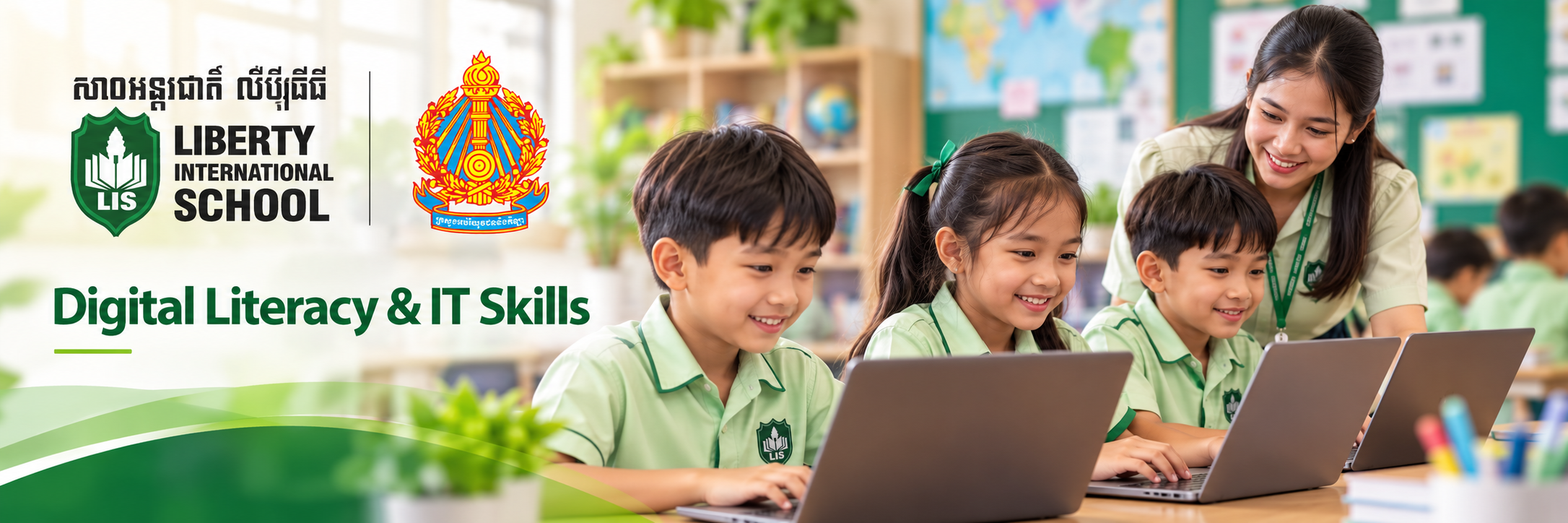
Digital Literacy, Coding & AI Education for Primary Students in Phnom Penh
Liberty International School (LIS) provides digital literacy and technology education as part of its international primary school program for Grades 1–6 in Phnom Penh, Cambodia.
Our goal is to help children become confident, creative, responsible, and thoughtful users of technology. We teach students not only how to use computers, but also how to solve problems, create digital content, communicate effectively, and understand emerging technologies such as artificial intelligence.
Digital literacy is integrated into our broader approach to international education, complementing English Language Arts, Mathematics, Science, STEAM, and critical thinking.
Preparing Children for a Digital Future
Technology is transforming education, communication, business, and everyday life. Children growing up today will need skills that extend beyond basic computer use.
At Liberty International School, we believe digital literacy should develop alongside traditional literacy and mathematical understanding.
Our approach focuses on three important foundations:
- Traditional Literacy: Reading, writing, communication, and understanding information.
- Mathematical Literacy: Numeracy, reasoning, patterns, logic, and problem-solving.
- Digital Literacy: Understanding and using technology effectively, creatively, safely, and responsibly.
Together, these skills help prepare children to become independent learners who can adapt to new technologies and changing educational opportunities.
What Students Learn in Digital Literacy
Our Digital Literacy and IT Skills program introduces age-appropriate learning experiences throughout the primary years.
Students develop skills in:
- Computer fundamentals and keyboarding.
- Word processing and document creation.
- Internet research and information literacy.
- Online safety and digital citizenship.
- Digital drawing, art, and graphic design.
- Presentations and digital communication.
- Scratch programming and computational thinking.
- Animation, storytelling, and digital media.
- Web design and introductory 3D modeling.
- Spreadsheets and basic data organization.
- Age-appropriate artificial intelligence concepts.
Our emphasis is on helping students understand how technology works and how it can be used to learn, create, communicate, and solve problems.
Digital Literacy Learning Progression: Grades 1–6
Digital learning at Liberty International School develops progressively as students gain confidence and experience.
Grades 1–2: Computer Fundamentals and Digital Confidence
In the early primary years, children are introduced to computers as educational and creative tools.
Learning activities include:
- Understanding basic computer functions.
- Developing introductory keyboard and mouse skills.
- Creating simple documents and digital drawings.
- Using presentations and creative applications.
- Learning basic internet safety.
- Exploring introductory coding through visual programming activities.
At this stage, the emphasis is on confidence, curiosity, independence, and positive technology habits.
Grades 3–4: Digital Creativity, Communication, and Coding
As students become more comfortable with technology, they begin using digital tools to organize information, communicate ideas, and develop creative projects.
Learning activities include:
- Word processing and document formatting.
- Digital research and presentations.
- Desktop publishing and creative design.
- Scratch programming and computational thinking.
- Animation and digital storytelling.
- Responsible internet research and communication.
These activities help students connect technology skills with literacy, mathematics, creativity, and classroom learning.
Grades 5–6: Programming, Digital Design, and Emerging Technologies
Upper primary students explore more advanced digital concepts and begin applying their knowledge through increasingly independent projects.
Learning areas include:
- Game development using Scratch.
- Web design and digital content creation.
- Introductory 3D modeling.
- Spreadsheets and data organization.
- Animation and digital media production.
- Programming logic and problem-solving.
- Artificial intelligence concepts and responsible AI use.
These experiences encourage students to think creatively, approach problems systematically, and use technology as a productive learning tool.
Artificial Intelligence Education for Children
Artificial Intelligence (AI) is becoming an important part of education, communication, business, and everyday life.
At Liberty International School, we introduce upper primary students to age-appropriate AI concepts, helping them understand both the opportunities and limitations of this technology.
Students explore questions such as:
- What is artificial intelligence?
- How does AI differ from traditional computer programs?
- How can computers recognize patterns and use information?
- Where do we encounter AI in everyday life?
- Can AI-generated answers contain errors?
- How can we use AI responsibly and safely?
We emphasize critical thinking, human judgment, privacy, creativity, and responsible technology use.
Our goal is not simply to teach children how to use AI tools, but to help them understand the technology and develop the judgment needed to use it appropriately.
Coding and Computational Thinking
Coding introduces children to a different way of thinking. Programming activities help students break problems into smaller steps, recognize patterns, test ideas, and improve solutions.
Our digital learning activities introduce visual programming tools such as Scratch and other age-appropriate programming environments.
Through coding, students develop:
- Logical and sequential thinking.
- Problem-solving and reasoning.
- Creativity and experimentation.
- Persistence when challenges arise.
- Planning and organization.
- Confidence in learning new skills.
These abilities are valuable beyond computer programming and can support learning across many academic subjects.
Online Safety and Digital Citizenship
Knowing how to use technology is only one part of digital literacy. Children also need to understand how to behave responsibly in online environments.
Our program introduces age-appropriate digital citizenship concepts, including:
- Protecting personal information and privacy.
- Safe and responsible internet use.
- Recognizing misleading or unreliable information.
- Respectful online communication.
- Understanding digital footprints.
- Responsible use of digital content.
- Asking trusted adults for help when needed.
These lessons help students develop positive habits that support safe and responsible technology use at school and at home.
Connecting Digital Literacy with STEAM Education
Digital literacy and STEAM education complement each other by encouraging curiosity, creativity, investigation, and practical problem-solving.
At Liberty International School, STEAM brings together Science, Technology, Engineering, the Arts, and Mathematics.
Students can apply digital skills to projects involving research, presentations, programming, design, and creative expression.
For example, coding can develop logical reasoning, digital design can support artistic creativity, and presentations can help students communicate scientific ideas.
Learn More About STEAM-Based Learning at Liberty International School
Technology Supports Learning — Teachers Remain Essential
We believe technology should support good teaching rather than replace it.
Our teachers guide students as they explore digital tools, develop new skills, and learn to use technology thoughtfully.
Structured lessons, practical activities, classroom discussion, and teacher feedback remain central to the learning process.
Our approach emphasizes that technology is most valuable when it strengthens a child's understanding, creativity, communication, and confidence.
Digital Literacy Within Our International Primary School
Digital Literacy and IT Skills form part of the broader educational program at Liberty International School.
Our Primary School combines a US-centric international academic approach with the Cambodian national Khmer curriculum, Chinese language learning, STEAM education, and creative activities.
Liberty International School is licensed by Cambodia's Ministry of Education, Youth and Sport (MoEYS).
We aim to provide students with strong academic foundations while introducing the digital skills they will need for future learning.
Explore Our International Primary School, Grades 1–6
Frequently Asked Questions About Digital Literacy
What is digital literacy for primary school students?
Digital literacy is the ability to use technology effectively, safely, responsibly, and creatively. It includes computer skills, internet research, digital communication, coding, information evaluation, and digital citizenship.
At what grade do students begin learning digital literacy?
Our structured primary Digital Literacy and IT Skills program begins in Grade 1 and develops progressively through Grade 6.
Does Liberty International School teach coding?
Yes. Coding and computational thinking are introduced through age-appropriate programming activities, including visual programming tools such as Scratch.
Does the school teach artificial intelligence?
Yes. Upper primary students are introduced to age-appropriate AI concepts, including how AI works, its applications, limitations, and responsible use.
Is online safety included?
Yes. Online safety, privacy, responsible internet use, and digital citizenship are important elements of our digital literacy approach.
Does digital literacy replace traditional academic subjects?
No. Digital literacy complements traditional subjects such as English, Mathematics, and Science. We believe strong academic foundations remain essential for effective technology use.
How can parents learn more about the program?
Parents are welcome to contact Liberty International School or arrange a campus visit to discuss digital learning, coding, AI education, and our wider Primary School curriculum.
Additional Information and Educational Resources
- International Primary School – Grades 1–6
- STEAM-Based Learning
- Academic Programs Overview
- Liberty International School Learning Management System
- International Primary School Brochure 2026–2027 (PDF)
- Frequently Asked Questions
- Admissions and Enrollment
Visit Liberty International School in Phnom Penh
We welcome parents who want to learn how digital literacy, coding, and emerging technologies fit into our international primary education program.
Choosing a school involves understanding not only what children learn, but also how they learn and how teachers support their development.
Liberty International School
#168, Street 156
Phnom Penh, Cambodia
Phone / Telegram: 095 712 165
Telegram: Chat With Liberty International School
Google Maps: Find Liberty International School in Phnom Penh
Admissions: Learn About Enrollment and School Visits
At Liberty International School, we combine strong academic foundations with digital knowledge, creativity, critical thinking, and responsible technology use to help prepare children for the future.